
Giselle Synopsis
Act 1
Set in a sun-warmed Rhineland village overflowing with the richness of harvest, the ballet begins with the rhythmic joy of grape gathering, dancing, and celebration. At the heart of this abundance is Signora Del Dotto, Giselle’s mother, a respected winemaker whose livelihood and identity are entwined with the vineyard. She watches over her daughter, Giselle, a delicate and luminous young woman, known for her intricate embroidery. Giselle’s love of folk dancing belies a fragile constitution, and, as her mother fears, a dangerously open heart.
Before the village fully awakens, a nobleman arrives in disguise: Albrecht, accompanied by his loyal friend, Wilfred. In a quiet but telling moment, Wilfred helps Albrecht conceal his true identity, urging him to hide his sword, an unmistakable symbol of nobility. This small but crucial detail plants the seed of the deception that will later unravel everything. Alone, Albrecht knocks on Giselle’s cottage door.
Their first encounter is one of the ballet’s most iconic and tender scenes. Giselle emerges shy but curious, and the two quickly fall into an innocent, playful courtship. In a simple yet deeply symbolic gesture, they pluck the petals from a daisy, asking “he loves me, he loves me not.” Giselle, unwilling to accept anything but the dream of true love, believes Albrecht’s deceitful happy ending, an early glimpse of both her romantic idealism and her refusal to see danger.
Watching from the shadows is Hilarion, the village gamekeeper, who harbors his own love for Giselle. Suspicious of Albrecht from the start, he notices inconsistencies in his behavior. When the two men briefly clash over Giselle, Hilarion observes Albrecht instinctively reach for a weapon that should not be there, another clue that something is amiss.
Giselle introduces Albrecht to her friends who show off their bountiful grape harvest. She displays her passion for dancing and teaches him the village waltz. Signora Del Dotto enters the village square and asks what Giselle has been doing. Giselle admits to her mother that she has been dancing, to her mother’s growing alarm. In a powerful mime scene, Signora Del Dotto attempts to warn her daughter of the Wilis. She tells the villagers that as they sleep, in the graveyard outside the village, vengeful spirits of young women betrayed before their wedding day rise from their graves and haunt the woods until dawn. She recounts their fate through vivid gesture, and warns that these veiled spirits will make men, and in particular Albrecht, dance until he dies. Her fear intensifies as she envisions a ghostly Wili drifting among the vines, a chilling premonition that Giselle’s joy may soon turn to tragedy.
The celebration is interrupted by the arrival of local nobility on a leisurely outing through the vineyards. Bathilde, who is the betrothed of Albrecht, and her cousin, The Duke of Courland, appear as refined aristocrats enjoying the harvest and sampling Signora Del Dotto’s wines. Unaware of Giselle’s connection to Albrecht, Bathilde is charmed by the young peasant girl who tells her of her own young love. She offers Giselle a necklace, a gesture of kindness that will soon take on tragic irony.
To thank Bathilde and taking heed of her mother’s warnings, Giselle says that though she herself will not dance, her closest friends will dance in her place. Six young peasants perform the iconic Peasant Pas de Deux, restaged as a Pas de Six (dance for six people).
The Duke and Bathilde retire into Signora Del Dotto’s cottage to rest. Hilarion searches for signs of Albrecht’s duplicity. He discovers Albrecht’s hidden sword and realizes the truth: this “villager” is a nobleman in disguise.
Giselle is named Queen of the Grape Harvest, and even Signora Del Dotto joins in the merrymaking with the children of the village. Swept away by the festivities, Giselle’s mother agrees that she may dance just this one time to celebrate. Giselle dances a famous solo variation, one of the mainstays of the classical repertoire, known for its difficult hops on pointe, balances and turns.
Hilarion can contain his rage and suspicions no longer, and he presents Albrecht’s sword to Giselle as proof. The deception is undeniable, only a nobleman would carry such a weapon. To further prove Albrecht’s true identity, Hilarion sounds the horn that calls the noble party to gather. Bathilde emerges from the Del Dotto cottage and recognizes Albrecht as her betrothed.
What follows is the ballet’s most acclaimed and devastating sequence: the mad scene. Giselle’s world collapses as love, betrayal, and humiliation overwhelm her fragile mind. She relives moments of joy, the daisy, the dancing, the promise of love, now fractured and distorted. Her movements become erratic, her expressions hollow with shock and grief. In a final, heartbreaking act, she seizes Albrecht’s sword, the very object that revealed his betrayal, and stabs herself. She dies as the harvest celebration falls into stunned silence, her mother’s warnings tragically fulfilled. Wilfred, too late to prevent the catastrophe, pulls the shattered Albrecht away from Giselle’s lifeless body.
Act 2
The second act shifts into a realm of haunting beauty and terror. In a moonlit forest cloaked in mist, Hilarion and a group of mourners stand vigil at Giselle’s grave. Eerie lights and sounds startle them, and they are chased from the graveside by an uncanny sense of fear.
Myrta, the implaccable Queen of the Wilis, drifts through the graveyard. She wields great power, using the herbs and plants of the forest as an evocation to bring forth her army of Wilis, the spirits of young women who have died betrayed before their wedding day. Their movements are ethereal yet relentless, their purpose singular: to exact revenge on men who have betrayed love. Moina and Zulma are Myrtha’s two handmaidens, and they tell their stories of betrayal through evocative classical repertoire.
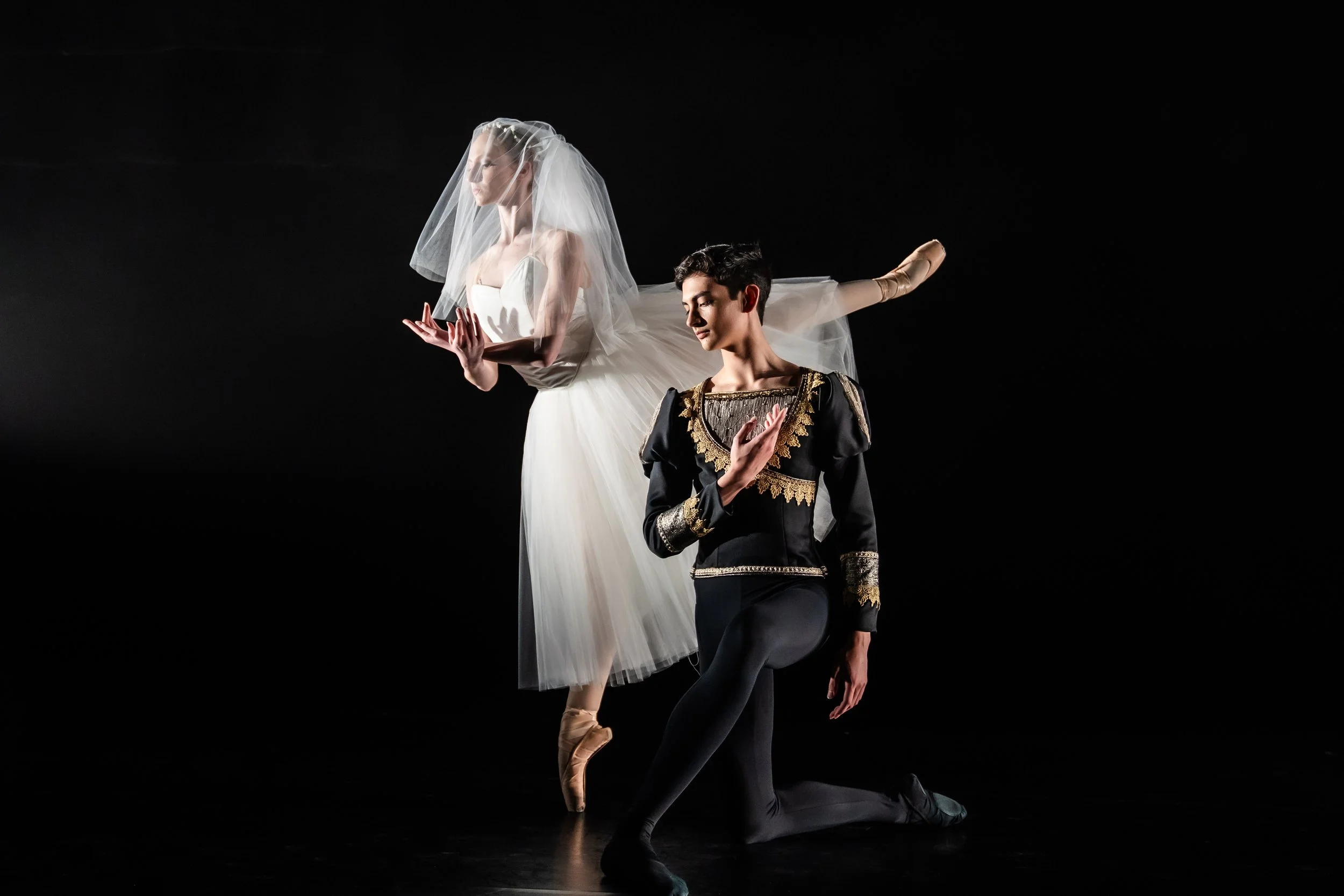
Myrtha summons forth Giselle, who rises obediently from the grave. Now a Wili herself, Giselle emerges transformed, draped in white, her earthly innocence transfigured into something otherworldly.
Yet when Albrecht arrives at her grave, consumed by remorse and genuine love, Giselle’s spirit reveals its enduring humanity. Though bound to the Wilis, she cannot join in their vengeance.
Hilarion is chased back into the graveyard by Moyna, Zulma and the avenging Wilis. Commanded by Myrtha, the Wilis force Hilarion to dance until he collapses and expires.
The Wilis next find Albrecht and chase him towards their Queen. Myrtha commands him to dance, holding a staff of rosemary, a romantic symbol of remembrance. Giselle places herself between Myrtha and Albrecht, and the power of her true love weakens Myrtha’s magic. Giselle begs for Albrecht’s life, and begins to dance with him and for him, to save him from dancing until his death.
In the ballet’s climactic pas de deux, danced to a viola solo renowned by musicians and music lovers worldwide, Giselle dances with Albrecht not to destroy him, but to save him. She supports him through the Wilis’ deadly command to dance, guiding him, lifting him, and sustaining him as the night stretches on. The supernatural atmosphere intensifies, the Wilis close in, Myrtha commands, the forest seems alive with ghostly energy, but Giselle’s love holds firm.
As Albrecht reaches the end of his strength, the sun begins to rise and the Wilis lose their power and vanish. Albrecht is spared, collapsing in exhaustion but alive. Giselle, her strength fading with the night, returns to her grave. She has transcended the fate foretold by her mother, not through vengeance, but through love. In the stillness of morning, Albrecht is left alone, forever marked by the ghostly memory of Giselle: a love that endured betrayal, death, and the pull of the supernatural beyond the grave.